

When you and I talk about studying business management degree in the USA, we’re really unpacking one of the most powerful career decisions anyone can make today. As global markets shift, technology accelerates, and companies search for adaptable professionals, choosing a US business program becomes not just a qualification—but a strategic investment in your future.
In this guide, we’ll walk through why these programs matter, who can study, how admissions work, detailed insights into the top 10 institutions, career outcomes, financial expectations, and what you can realistically gain from this journey.
Why Do Business Management Programs in the USA?
When we think about business education, I’m sure you picture numbers, markets, profit graphs, and maybe a case study or two. But business studies are much broader—and far more impactful—than that. In the US, these programs shape how you think, how you solve problems, and how you grow as a leader.
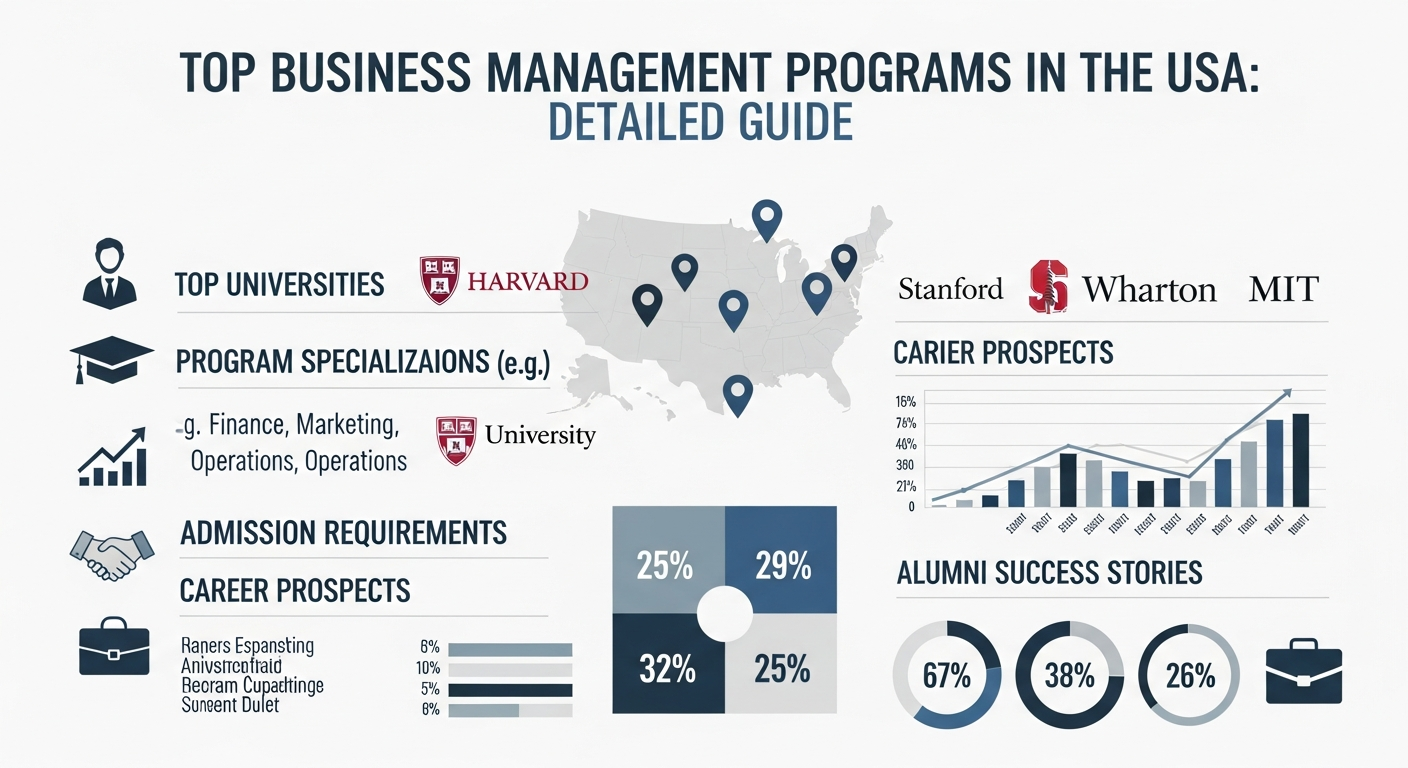
Stick with this blog and I’ll help you navigate everything with ease. I’ve pulled together the key information from all three sources so you can feel informed, confident, and ready to move forward.
A Global Hub of Business Education
The United States hosts the world’s most prestigious institutions—Harvard, Stanford, Wharton, MIT Sloan, Chicago Booth, NYU Stern, and others. What makes them stand out for students like us is:
- Cutting-edge research
- Real-world immersion
- Industry-linked coursework
- Cross-cultural cohorts
- Immediate access to corporate recruiters
These schools’ alumni lead Fortune 500 companies, build investor-backed startups, manage government agencies, and launch global ventures.
Why Business Still Matters in 2025
Here’s what the latest data and trends tell us:
- Versatile Skill Set: You gain analytical, financial, operational, and managerial skills that translate across industries.
- Entrepreneurship Ecosystem: With Silicon Valley, Wall Street, and major innovation hubs, the US gives you direct exposure to venture capital, incubators, and tech accelerators.
- Global Perspective: Classes often include students from 80–100+ countries, giving you unmatched cultural agility.
- Leadership and Ethics: Programs emphasize responsible management, sustainability, DEI, and ethical decision-making.
- High ROI: Top MBA graduates regularly report $150,000–$175,000+ median salaries, often achieving payback within 2–3 years.
In simple terms: business education in the USA helps you thrive in uncertainty, innovate confidently, and lead boldly.
Who Can Pursue Business in the USA? Eligibility Made Simple
Whether you’re a high school student, a working professional, or someone considering a mid-career pivot, US business programs are designed with multiple pathways.
Undergraduate Programs (BBA/BS in Business)
You can apply straight after high school. Requirements generally include:
- Strong GPA (3.5+ recommended)
- SAT/ACT (optional at many schools but still helpful)
- TOEFL/IELTS for international students (TOEFL 100+ recommended)
- Leadership activities, essays, and recommendation letters
Programs like Wharton, Ross, NYU Stern, and Haas offer direct admission. Others let you start in general studies and transfer into business through a 2+2 pathway.
Graduate Programs (MBA, MS, MFin, Analytics, etc.)
Graduate entry is broader. You qualify if:
- You hold a bachelor’s degree (any major)
- You meet test expectations: GMAT 700+, GRE 320+ for top programs
- You bring 2–5 years of work experience (for MBAs)
- You demonstrate leadership, clarity of career goals, and strong recommendations
Executive MBAs
If you’ve worked 5–10+ years and want advanced leadership training, EMBA programs are perfect. These are tailored for managers and offer weekend or modular formats.
International Students
As long as you meet:
- Academic standards
- English proficiency
- Visa requirements
- Financial documentation
—you can apply to all major US institutions.
Top 10 Business Schools in the USA (2025)
To help you compare options easily, I’ve combined rankings, strengths, and key features from all sources.
1. Wharton School – University of Pennsylvania
Philadelphia, PA
Strengths: Finance, analytics, global strategy
Programs: MBA, B.S. in Economics, EMBA, MS Analytics
Highlights:
- 20+ majors
- Venture Lab and entrepreneurial ecosystem
- 95% employment within three months
- Alumni network includes founders like Elon Musk
Avg GMAT: 733
2. Stanford Graduate School of Business
Stanford, CA
Strengths: Innovation, entrepreneurship, tech
Programs: MBA, MSx, PhD
Highlights:
- Close ties to Silicon Valley
- Access to seed funding
- 97% placement rate
Avg GMAT: 738
3. Kellogg School of Management – Northwestern University
Evanston, IL
Strengths: Marketing, leadership, consulting
Programs: 1-year MBA, 2-year MBA, part-time MBA, undergrad options
Highlights:
- Team-focused culture
- Global learning hubs
Avg GMAT: 729
4. University of Chicago – Booth School of Business
Chicago, IL
Strengths: Finance, data analytics, leadership
Highlights:
- Flexible curriculum
- Polsky Center for Entrepreneurship
- 98% placement
Avg GMAT: 726
5. Harvard Business School
Boston, MA
Strengths: Case method, management, global outlook
Highlights:
- 500+ case studies annually
- Global research centers
- 94% placement
Avg GMAT: 730
6. MIT Sloan School of Management
Cambridge, MA
Strengths: Tech-management integration, research, innovation
Highlights:
- Action learning labs
- Entrepreneurship centers
- 96% placement
Avg GMAT: 730
7. Columbia Business School
New York, NY
Strengths: Finance, global business, media/entertainment
Highlights:
- Wall Street proximity
- Strong venture & fintech ecosystem
Avg GMAT: 732
8. UC Berkeley – Haas School of Business
Berkeley, CA
Strengths: Sustainability, innovation, entrepreneurship
Highlights:
- Cleantech-to-Market program
- Bay Area partnerships
Avg GMAT: 729
9. NYU Stern School of Business
New York, NY
Strengths: Finance, entertainment, technology
Highlights:
- Global study options
- Powerful NYC corporate connections
Avg GMAT: 732
10. University of Michigan – Ross School of Business
Ann Arbor, MI
Strengths: Action-based learning, career mobility
Highlights:
- Multidisciplinary Action Projects
- 94% placement
Avg GMAT: 720
Quick-View Comparison Table
| Institution | Key Strength | Annual Tuition (MBA 2025) | Avg Scholarship |
|---|---|---|---|
| Wharton | Finance, Analytics | $84,830 | $40,000 |
| Stanford GSB | Entrepreneurship | $82,455 | $45,000 |
| Kellogg | Leadership | $83,610 | $35,000 |
| Booth | Finance | $81,189 | $30,000 |
| Harvard | Management | $76,410 | $42,000 |
| MIT Sloan | Tech-Business | $82,000 | $38,000 |
| Columbia | Wall Street Access | $84,496 | $25,000 |
| UC Berkeley Haas | Innovation | $72,000 | $20,000 |
| NYU Stern | Finance/Tech | $82,326 | $28,000 |
| Michigan Ross | Action Learning | $75,000 | $32,000 |
Career Opportunities: What You Can Do After Studying Business
One of the biggest reasons you and I consider US business programs is their career reach. When you graduate from these institutions, the doors that open are global, diverse, and often highly lucrative.
Top Career Paths
- Finance: Investment banking, asset management, private equity
- Consulting: Strategy, operations, digital transformation
- Marketing: Brand management, digital marketing, product marketing
- Technology: Product management, business operations, analytics
- Entrepreneurship: Startups, family business expansion, social enterprises
- Public Sector & NGOs: Policy, sustainability, development
Expected Salary Ranges
- Investment Banker: $150k+ starting
- Management Consultant: $175k–$200k with bonuses
- Tech Product Manager: ~$160k
- Marketing Manager: ~$156k median
- Operations Director: $140k+
Long-term? US business school alumni commonly become CEOs, founders, venture investors, and global leaders.
Pricing, Funding, and Financial Planning
Yes, business education in the USA is expensive—but with smart planning, financial aid, and high ROI, it becomes a powerful investment.
Tuition Overview
- Elite private MBA programs: $70,000–$85,000 per year
- Undergraduate degrees: $50,000–$70,000 per year
- Public universities: $5,000–$20,000 per year
Living Expenses
- Major US cities: $20,000–$30,000 annually
- Smaller cities/towns: $10,000–$20,000
Scholarships & Aid
You can apply for:
- Merit scholarships
- Fellowships
- Graduate assistantships
- Need-based grants
- Employer sponsorships
- US federal loans (for eligible categories)
Most top programs cover 30%–50% of tuition through scholarship packages.
What Institutions Provide Beyond Academics
Business schools today aren’t just about textbooks. Here’s what you and I experience once we step inside:
- State-of-the-art innovation labs
- Case-study classrooms
- Study abroad immersion programs
- Incubator and accelerator access
- Industry networking events
- Dedicated career support
- Leadership and communication coaching
You also choose from specializations like:
- Finance
- Marketing
- Entrepreneurship
- Analytics
- Supply Chain
- Sustainability
- Healthcare Management
- Global Strategy
Final Thoughts
If you’re here, you’re clearly focused on becoming a global business leader. Keep up the momentum—your consistent hard work will get you there.
Studying business in the USA is more than earning a degree—it’s about transforming how you think, lead, and build your career. Whether your dream is to join a top consulting firm, launch a startup, scale a family business, or work on global issues, these programs give you the platform, network, and confidence you need.
If you’re serious about applying, here’s what you can do next:
- Research admission deadlines
- Start preparing essays early
- Reach out to alumni on LinkedIn
- Attend school webinars or virtual tours
- Strengthen your résumé and academic profile
Your journey to becoming a future business leader starts with the decision you make today—and I’m here to help you at every step.



Leave a Reply