

Skills and education are two central pillars of career development. While formal education provides foundational knowledge and recognized credentials, practical skills demonstrate real-world capability. In today’s rapidly evolving job market, skills are increasingly viewed as the primary driver of employability and long-term growth.
Skills and Education Overview
In a showdown that has been brewing for years, Education and Skills once again went head-to-head, and this time, the gap between the two was more visible than ever. For decades, education held the upper hand—backed by degrees, grades, and big institutions. But in today’s job arena, especially in 2025, skills are charging back hard, almost like a lower-order batsman turning the match around in the final overs.
This article provides an in-depth overview of the relationship between skills and education, including when each matters most, how employers evaluate them, and why a balanced approach remains ideal.
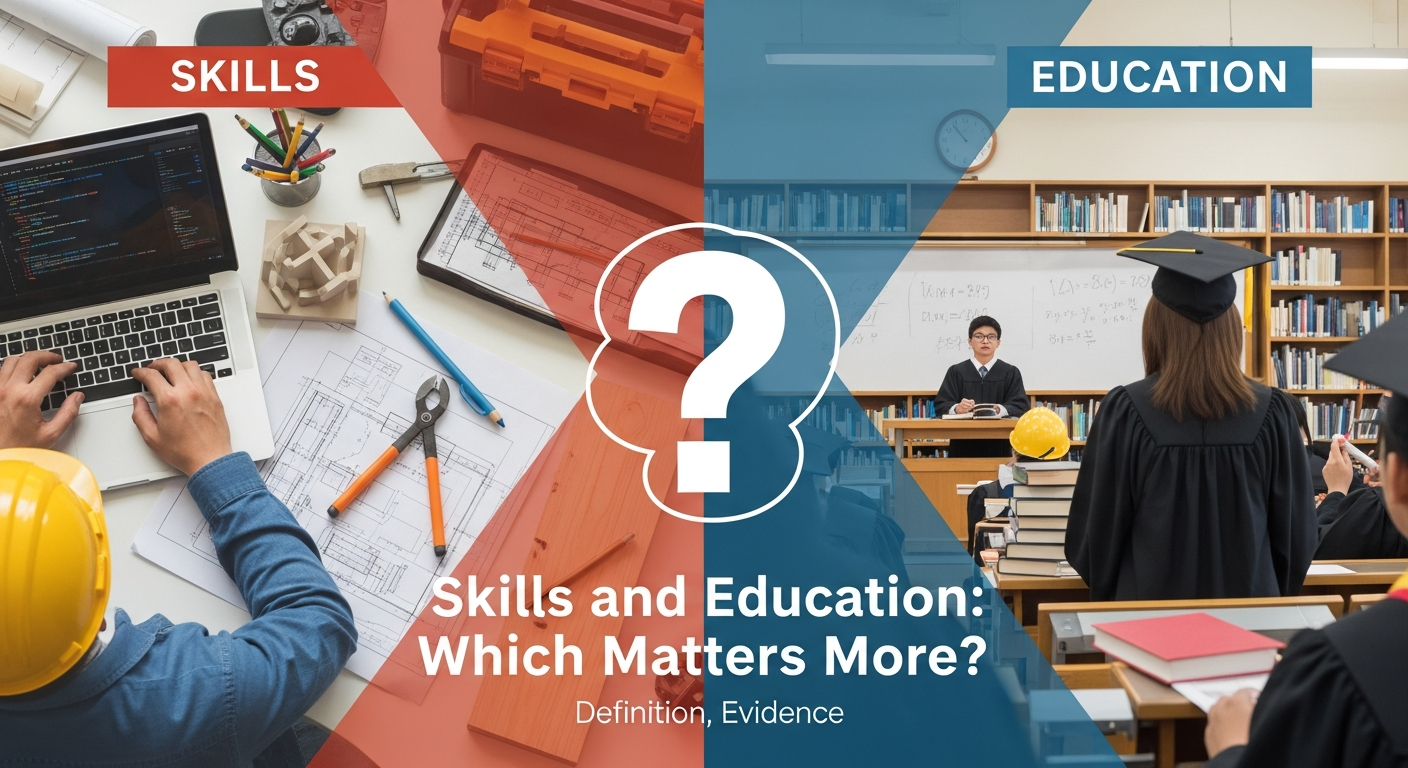
Table of Contents
- Real-World Example
- Comparative Overview
- The Role of Education
- The Growing Importance of Skills
- Balancing Skills and Education
Definition
Education came in with its usual armour—degrees, diplomas, structured coursework, all from established institutions. Skills, on the other hand, walked out with practical experience, hands-on prowess, and abilities sharpened through real-world challenges.
While education draws strength from schools, colleges, and universities—your IITs and CBSE boards—skills are born in the wild: on-the-job training, personal projects, certifications, and even hobbies that turn into expertise.
Education focuses on theory, frameworks, and structured learning, much like pre-match strategies. Skills bring execution, problem-solving, and performance, the on-field action that actually changes the scoreboard.
Examples
- Education brings its B.Tech degrees and top PCM scores.
- Skills walks in with advanced Python mastery and an AWS Solutions Architect badge—the kind of things that win matches in the tech arena.
How to Measure and How Long Take It
Measurement
Education is judged by CGPA, marks, percentages.
Skills are measured by results—like “Built an ML model that reduced errors by 25%.” It’s the difference between net practice and scoring runs under pressure.
Duration
Education has fixed timelines—four-year degrees, one-year courses.
Skills? Lifelong and ongoing, constantly updated, much like a player adapting to new formats.
Transferability
Education enjoys broad recognition and easy verification.
Skills often need proof—portfolios, demos, assessments, similar to a player proving match fitness before selection.
Pros & Cons
Education gives you credibility and foundations, but can become outdated.
Skills are agile, powerful, and directly tied to performance, but require regular upskilling—no room for complacency.
1. When Education Matters
Education offers a structured, theory-driven foundation that supports long-term intellectual and professional growth. It is particularly valuable when the goal is to build credibility or work in regulated fields.
Key Functions of Education
- Foundation of Knowledge
Formal education cultivates critical thinking, theoretical understanding, literacy, and domain-specific concepts. - Credentials and Recognition
Degrees act as standardized proof of competence, often required to enter or advance in certain professions. - Exposure to Diverse Subjects
Academic programs encourage broad learning and help students understand multiple perspectives. - Networking Opportunities
Universities and colleges connect students with peers, mentors, faculty, and future employers.
Where Education Is Essential
Education remains legally or professionally required in:
- Medicine
- Law
- Engineering
- Academia
- Research-intensive roles
Despite its strengths, education alone is no longer sufficient for job readiness. In India, for instance, only 45–51% of graduates are considered industry-ready due to a persistent skill gap.
2. When Skills Matter More
Skills—both technical and soft—show what an individual can do, not just what they know. As industries shift rapidly, employers increasingly prioritize skills over degrees.
Why Skills Dominate Today
- Direct Practical Application
Skills like coding, communication, data analysis, or problem-solving translate immediately into workplace value. - Hiring Trends
A majority of recruiters report prioritizing skill proficiency. Many companies, including Apple, Google, and IBM, have reduced or removed degree requirements for numerous roles. - Adaptability in Fast-Changing Fields
With technology evolving quickly, skills can be updated far faster than academic curricula. - Global Workforce Shift
Skills are increasingly considered the “new currency” of employability.
For example, skilled trades or tech certifications often yield higher starting salaries than some traditional degrees.
Evidence from Hiring Data
- Recruiters identify skills gaps as the biggest challenge in filling roles.
- Soft skills such as adaptability, teamwork, and leadership are rated nearly as important as technical expertise.
- Many high-demand, well-paying jobs do not require a bachelor’s degree if candidates can demonstrate skills through portfolios or certifications.
3. Finding the Balance: Skills + Education
A combined approach offers the strongest career advantage. Education builds intellectual depth and credibility; skills ensure practical effectiveness.
Imbalances to Avoid
- Education without Skills:
Graduates may lack job-ready experience and struggle to meet industry expectations. - Skills without Education:
Individuals may excel in practice but face limitations in fields that require formal qualifications or a theoretical foundation.
The Ideal Approach
- Use education to build conceptual understanding.
- Use skills to remain relevant, employable, and adaptable.
- Embrace continuous learning through online courses, certifications, and hands-on projects.
4. Real-World Example: Software Engineering
A software engineer illustrates the relationship clearly:
- Education provides grounding in algorithms, data structures, systems design, and computational theory.
- Skills such as Python programming, debugging, teamwork, and version control enable actual job performance.
Without education, depth and scalability may be limited; without skills, execution becomes difficult.
5. Comparative Overview
| Aspect | Skills Advantage | Education Advantage |
|---|---|---|
| Hiring | Demonstrated via portfolios and real projects | Provides a quick screening filter |
| Growth | Adapts with new tools, trends, and technologies | Offers structured, disciplined learning |
| Cost & Time | Low-cost courses; fast learning cycles | Higher cost and longer duration |
| Best Suited For | Tech, sales, digital fields, entrepreneurship, trades | Regulated professions and research |
Conclusion
Skills are increasingly central to employability in today’s economy, offering flexibility, relevance, and immediate value. Education remains vital for foundational learning and professional credibility, especially in regulated sectors. The strongest career outcomes arise from combining both—using education as a base and skills as the engine of career advancement.


Leave a Reply