


Every business must analysis Risk management SWOT at time of new business launch, new process implementation, or business loans. Here, we can analysis multiple factor Which like a Strengths, Weaknesses, Opportunities, and Threats. This A risk management SWOT analysis is a structured way to identify a business’s SWOT factors. Within this report, you will find an overview of small business challenges.
Risk Management SWOT Analysis
Many people are unaware of powerful tools like SWOT analysis that can transform the way we approach risk management—whether for a startup company, a new project, or even something as complex as an election. This method shines because it helps us see clearly where risks and vulnerabilities lie, by examining both what we can control (our strengths and weaknesses) and what the world throws at us (opportunities and threats).
The Threats quadrant is especially vital—it forces us to confront external challenges head-on, from fierce competition to economic shifts or regulatory changes. Instead of being caught off guard, we gain the ability to anticipate, prepare, and rise above obstacles.
When you embrace this analysis, you’re not just managing risks—you’re building resilience, sharpening strategy, and unlocking opportunities that others might miss. It’s about turning uncertainty into confidence and challenges into steppingstones for success.
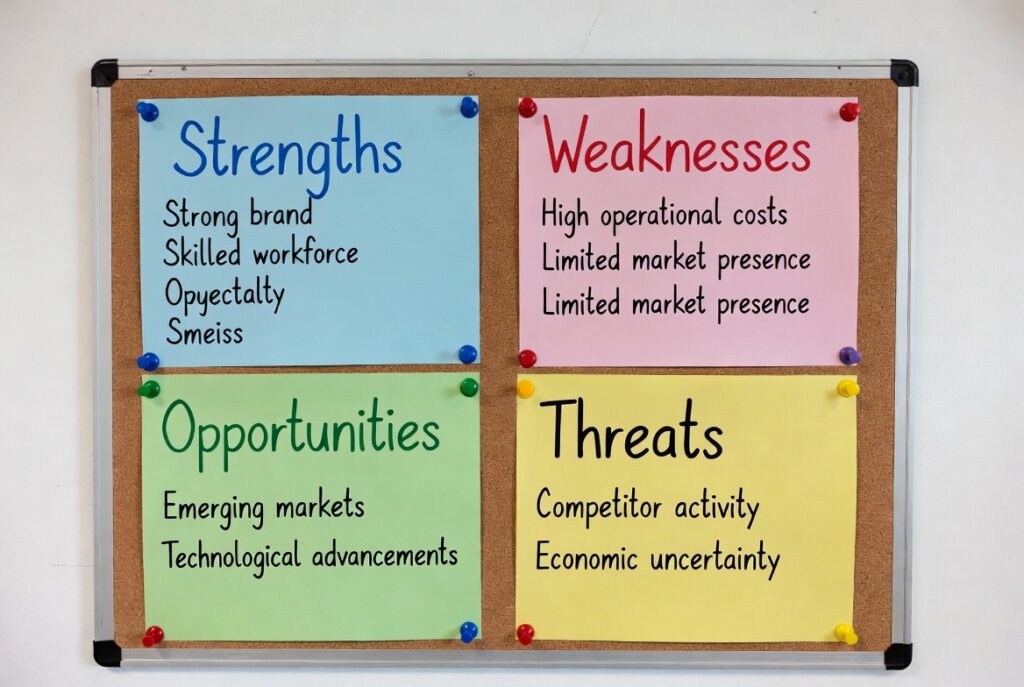
First introduced in the 1960s by Albert Humphrey at the Stanford Research Institute, the SWOT framework enables organizations to anticipate challenges and respond strategically. By converting observations into practical actions, businesses can reduce exposure to threats, strengthen weak areas, and take advantage of opportunities to maintain resilience.
How to Conduct a SWOT Analysis for Risk Management
A SWOT analysis for risk management is a structured, collaborative exercise that helps businesses uncover vulnerabilities, anticipate external challenges, and design strategies to strengthen resilience. By examining internal factors (strengths and weaknesses) alongside external factors (opportunities and threats), organizations can transform insights into actionable risk responses.
Step 1: Gather a Team
- Assemble a diverse group: managers, employees, and external experts.
- Multiple perspectives ensure risks are spotted from operational, financial, technological, and strategic angles.
- Workshops or structured meetings are ideal settings for this collaborative process.
Step 2: Define the Scope
- Clarify the business area or project under review (e.g., entering a new market, launching a product, or enterprise-wide risk).
- Focus on risk-related objectives: identifying vulnerabilities that could cause financial loss, compliance issues, or operational disruptions.
Step 3: Brainstorm Each Quadrant
- Strengths (Internal Positives):
- Examples: strong brand reputation, skilled workforce, robust financial reserves, advanced technology.
- Role: leverage these to buffer against risks.
- Weaknesses (Internal Negatives):
- Examples: outdated systems, skill gaps, high debt, supply chain dependencies.
- Role: recognize these as risk amplifiers that need mitigation.
- Opportunities (External Positives):
- Examples: emerging markets, favorable regulations, technological advancements, strategic partnerships.
- Role: exploit these to reduce risk exposure or create competitive advantages.
- Threats (External Risks):
- Examples: competitors, cyberattacks, economic downturns, regulatory changes, natural disasters.
- Role: prioritize these as critical risk factors requiring contingency planning.
Step 4: Prioritize and Analyze
- Rank risks by impact and likelihood using a risk matrix (high/medium/low).
- Cross-reference quadrants: e.g., how can strengths neutralize threats, or how can opportunities offset weaknesses?
- This step transforms brainstorming into structured risk intelligence.
Step 5: Develop Strategies
- Mitigation tactics: insurance, cybersecurity upgrades, diversification.
- Contingency plans: backup suppliers, crisis communication protocols.
- Strategic actions: use strengths to counter threats, address weaknesses to avoid exposure, and exploit opportunities responsibly.
Step 6: Review and Update
- Risks evolve—revisit the SWOT quarterly or after major business changes.
- Update inputs with fresh data: financial reports, compliance audits, market analysis, and stakeholder feedback.
- Continuous monitoring ensures relevance and adaptability.
Tools & Timing
- Tools: spreadsheets, whiteboards, or digital platforms like MindMeister or Lucidchart.
- Timeframe: 1–2 hours for a basic analysis; longer for complex businesses or enterprise-wide risk reviews.
How Effective Is SWOT Analysis in Risk Management?
By Business Insights Desk
In today’s volatile business environment, companies are increasingly turning to SWOT analysis as a cornerstone of risk management. Originally designed as a strategic planning tool, SWOT—short for Strengths, Weaknesses, Opportunities, and Threats—has proven highly effective in helping organizations anticipate and mitigate risks.
A Simple Yet Powerful Framework
What makes SWOT particularly appealing is its simplicity. Unlike complex risk modeling or advanced analytics, it requires no specialized expertise, making it accessible to small businesses and useful for quick evaluations. By systematically examining both internal factors and external forces, businesses gain a comprehensive view of their risk landscape.
Practical Effectiveness
Industry experts highlight several ways SWOT enhances risk management:
- Early Risk Detection: It uncovers hidden threats before they escalate.
- Strategic Alignment: Risks are linked directly to business goals, ensuring management efforts are not isolated but integrated.
- Quantitative Integration: When paired with tools like probability-impact matrices, SWOT becomes more data-driven, sharpening accuracy.
- Decision-Making Support: Leaders can prioritize which risks to tackle first, balancing resources effectively.
The Caveat
Despite its strengths, SWOT is not foolproof. Analysts warn that if conducted superficially—without diverse input or reliable data—it can lead to biased or incomplete results. A one-dimensional SWOT risks overlooking critical vulnerabilities.
Research Backing
Studies published in the Harvard Business Review reveal that businesses incorporating SWOT into risk management report 20–30% greater preparedness for uncertainties. However, experts emphasize that its true power emerges when combined with complementary frameworks such as PESTLE analysis (Political, Economic, Social, Technological, Legal, Environmental), which adds depth to external risk evaluation.
SWOT analysis remains a highly effective, foundational tool for risk management. Its accessibility and structured approach make it invaluable for organizations of all sizes. Yet, like any tool, its effectiveness depends on how thoroughly it is applied and whether it is integrated with broader analytical methods.
Benefits
- Cost-Effective – Requires minimal resources, no expensive tools or consultants needed initially.
- Enhances Decision-Making – Translates abstract risks into actionable strategies, improving resource allocation.
- Fosters Collaboration – Encourages team input and builds buy-in for risk mitigation plans.
- Adaptability – Scalable across industries and business sizes, from startups to global corporations.
- Proactive Approach – Shifts focus from reactive firefighting to preventive measures, saving costs.
- Clear Visualization – Offers a simple, structured view of the risk landscape.
- Cross-Functional Collaboration – Promotes diverse perspectives across departments.
- Improves Resilience & Adaptability – Strengthens the organization’s ability to withstand disruptions.
- Balances Risk & Opportunity – Helps avoid risks while leveraging opportunities for growth.
- Supports Compliance & Governance – Aligns risk management with regulatory and governance requirements.
- Competitive Advantage – Empowers businesses to turn risks into opportunities, enhancing resilience and market position.
Types
| Type | Description | Best Use Case |
|---|---|---|
| Standard SWOT | Basic four-quadrant model for general business risk assessment. | Broad, initial risk evaluations across any business or project. |
| TOWS Matrix | Extension of SWOT that matches elements (e.g., Strengths-Threats strategies). | Advanced risk mitigation planning and strategy formulation. |
| Quantitative SWOT | Assigns scores or weights (e.g., 1–10 scale) for impact and likelihood. | Data-heavy environments like finance, technology, or analytics-driven industries. |
| Sector-Specific SWOT | Tailored to industry contexts (e.g., healthcare, manufacturing). | Industry-specific risks such as regulatory compliance or supply chain issues. |
| Dynamic SWOT | Incorporates timelines or scenarios to track evolving risks. | Long-term projects or businesses facing fast-changing environments. |
| Integrated SWOT-PESTLE | Combines SWOT with macro-analysis (Political, Economic, Social, Technological, Legal, Environmental). | Volatile industries like energy, e-commerce, or global markets. |
Example of SWOT Analysis for Risk Management
Case Study: Eco-Friendly E-Commerce Startup Expanding Internationally
Strengths (Internal Positives)
- Strong online presence & loyal customer base: Provides a solid foundation for brand recognition in new markets.
- Efficient supply chain with local sustainable suppliers: Ensures reliability and supports eco-friendly positioning.
- Innovative social media marketing: Builds strong engagement and helps differentiate from competitors.
Risk Implication: These strengths can be leveraged to reduce market entry risks and build trust with international customers.
Weaknesses (Internal Negatives)
- Limited financial reserves for expansion: Restricts ability to absorb unexpected costs or losses.
- Dependence on a few key suppliers: Creates vulnerability if suppliers face disruptions or fail to meet international demand.
- Lack of international shipping experience: Increases risk of logistical errors, delays, and higher costs.
Risk Implication: Weaknesses expose the startup to financial instability and operational inefficiencies during expansion.
Opportunities (External Positives)
- Growing global demand for sustainable fashion: Expanding consumer interest aligns with the startup’s eco-friendly niche.
- Potential partnerships with international retailers: Opens doors to new distribution channels and credibility.
- Favorable trade agreements in target countries: Reduces tariffs and regulatory barriers, lowering entry costs.
Risk Implication: Opportunities can be harnessed to offset weaknesses and accelerate growth while minimizing entry risks.
Threats (External Risks)
- Currency fluctuations & economic instability abroad: Could erode profit margins and increase financial uncertainty.
- Intense competition from established brands: Larger players may dominate market share and outspend on marketing.
- Regulatory changes (tariffs, environmental laws): Could increase compliance costs or restrict operations.
Risk Implication: Threats represent critical external risks that must be anticipated and mitigated to avoid losses.
Strategies Derived
- Strengths–Threats (ST Strategy): Use strong marketing and sustainability branding to differentiate from competitors and counter their dominance.
- Weaknesses–Threats (WT Strategy): Diversify supplier base to reduce dependency and minimize supply chain risks from economic instability.
- Strengths–Opportunities (SO Strategy): Leverage loyal customer base and eco-friendly reputation to form partnerships with international retailers.
- Weaknesses–Opportunities (WO Strategy): Seek external funding or joint ventures to overcome financial limitations and tap into favorable trade agreements.
Overall Risk Management Plan
- Financial Risk Mitigation: Implement currency hedging to protect against exchange rate volatility.
- Operational Risk Mitigation: Invest in international logistics expertise and diversify suppliers.
- Strategic Risk Mitigation: Conduct market research to prioritize entry into countries with lower regulatory and competitive threats.
- Compliance Risk Mitigation: Monitor environmental and trade regulations closely to stay ahead of legal changes.
This example demonstrates how a SWOT analysis identifies risks and vulnerabilities while also highlighting opportunities. By mapping risks into the SWOT framework, the startup can proactively design strategies that reduce exposure, strengthen resilience, and improve the chances of successful international expansion.


Leave a Reply