


Online vocational schools are gateways to practical, career-focused education—designed to equip learners with real-world skills in fields like IT, healthcare, retail, and manufacturing. Whether you’re a student eager to fast-track your future, a professional sharpening your expertise, or a career changer ready for a fresh start, these programs offer recognized certifications that open doors—without ever stepping into a traditional lecture hall.
What Are Online Vocational Schools?
Common Vocational Fields & Programs in the USA
Online & Hybrid Vocational Schools in the USA
What Are Online Vocational Schools?
Many of these programs mix online learning with real-world practice, often including apprenticeships or fieldwork—especially for licensed careers like healthcare, HVAC, plumbing, and other skilled trades. Their core purpose is clear: to prepare students with the practical, job-ready abilities today’s employers expect.
Courses are typically self-paced, giving learners the flexibility to balance work, family, and education without stress. Most programs run 6 months to 2 years and finish with a certificate, diploma, or associate degree.
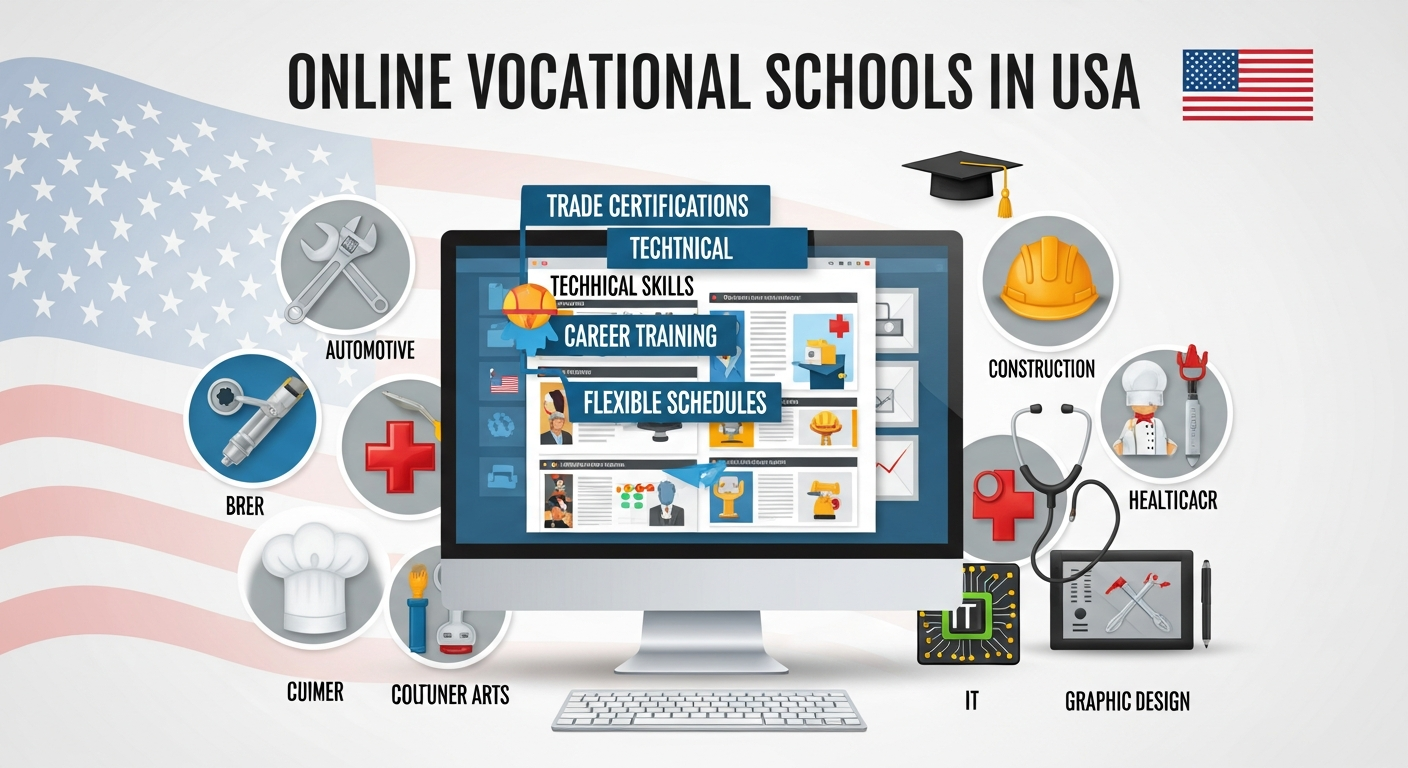
Even when most of the coursework is online, plenty of programs add hybrid elements such as in-person labs to build hands-on confidence. Starting the journey is straightforward too—requirements are usually just a high school diploma or GED, with rolling admissions and financial aid options available.
Benefits of Online Vocational Schools
- Recognized Career Credentials: Certifications are widely accepted by employers and universities, giving learners a clear path to career advancement.
- Practical & Industry-Focused: Programs emphasize hands-on training, assessments, and internships, preparing students for high-demand fields with quick entry opportunities (often 6–18 months).
- Flexible & Accessible Learning: Online enrollment makes education inclusive and convenient, allowing learners from anywhere to gain skills across multiple industries.
- Affordable Pathways: Vocational programs are typically more cost-effective than traditional degrees, offering career flexibility without heavy financial burden.
Common Vocational Fields & Programs in the USA
These offerings—many available online or in hybrid formats—are designed to equip learners with practical, job-ready skills in high-demand fields.
- Healthcare (Medical billing/coding, Assistant, Therapy)
- Information Technology and Computer Networking
- Business Administration and Bookkeeping
- Logistics and Entrepreneurship
- Facility, Multifamily, and Appliance Maintenance
- Paralegal, Social and Human Services
- Electrical, Plumbing, HVAC, Welding
Healthcare Vocational Training
Healthcare training remains one of the fastest-growing segments. Programs in Medical Billing & Coding are preparing students to handle insurance claims, ICD-10 and CPT coding systems, and administrative tasks. Meanwhile, Medical Assistant courses continue to attract those interested in clinical procedures and patient-care support. Institutions are also reporting increased interest in therapy-related support roles, including physical therapy aides, occupational therapy assistants, and rehabilitation assistants.
Tech & Networking Certifications
Information technology remains a cornerstone of career training. Courses in Computer Networking, featuring certifications from Cisco, CompTIA, and Microsoft, are equipping learners with skills in network setup and system security. Entry-level pathways like IT Support and Helpdesk continue to offer accessible on-ramps to the tech sector. Advanced programs in Cybersecurity and Cloud Computing are also expanding as organizations prioritize data protection and cloud-based operations.
Business and Administrative Careers
The business sector also shows strong interest, with institutions offering Business Administration training focused on management, operations, and leadership. Bookkeeping and Accounting programs are preparing students to handle financial records, payroll systems, and tax-related tasks—skills increasingly sought after by small businesses and startups.
Logistics and Entrepreneurship Programs
As global supply chains continue to evolve, Supply Chain Management programs are teaching students the fundamentals of inventory control, warehousing, and distribution. Parallel to this, Entrepreneurship courses are helping aspiring business owners develop skills in planning, marketing, and startup development.
Maintenance and Facility Management Training
In the residential and commercial sectors, programs such as Multifamily Housing Maintenance are training workers in plumbing, electrical systems, and appliance repair. Institutions report rising demand for Appliance Maintenance courses as well, reflecting a nationwide shortage of skilled technicians.
Legal and Social Services Programs
Legal support programs, particularly Paralegal Studies, are preparing students for roles involving legal research, document drafting, and attorney assistance. In the social sector, Social and Human Services training is equipping learners for careers in case management, community outreach, and counseling support.
Skilled Trades Training
Skilled trades continue to attract strong interest due to competitive wages and stable career prospects. Electrical, Plumbing, and HVAC programs are offering certification-ready training in installation, maintenance, and safety protocols. Meanwhile, Welding courses provide hands-on instruction in fabrication, blueprint reading, and industrial safety.
Online & Hybrid Vocational Schools in the USA
Among the leading accredited online vocational schools in the United States. The selection highlights institutions recognized for robust online programs, solid graduation outcomes, career placement assistance, and affordability. Prospective learners should confirm specific requirements, as certain courses may involve in-person clinical or lab sessions.
Penn Foster College (Online Nationwide)
- Programs: High school diploma, IT support, medical billing & coding, veterinary technician, AutoCAD, business administration, plus construction trades, electrical technician, HVACR, plumbing, and medical assistant.
- Length & Cost: 6–12 months; $800–$1,500 per program (flexible payments starting at $20/month; as low as $75/month depending on program).
- Training: Fully online, self-paced, accredited; strong job readiness focus with employer partnerships.
- Career Support: Career diplomas and degrees widely recognized by employers and universities.
North Dakota State College of Science (NDSCS) – Wahpeton, ND
- Programs: 75 career options including business, computer applications, accounting, healthcare, skilled trades, health information technology, communications technology, business management, pharmacy technician, and architectural drafting.
- Length & Cost: 1–2 years (certificates/associate degrees); $4,000–$6,926 annually (in-state); online per-credit tuition ~$220–253; scholarships up to $2,000 available.
- Training: Campus + online options via TrainND Southeast; Aspen Prize winner for community colleges.
- Career Support: Strong emphasis on social mobility and equity; career services; average graduate earnings ~$47,700 after 10 years.
Kennebec Valley Community College (KVCC) – Fairfield, ME
- Programs: 43 career programs; 11 online/hybrid including business, healthcare, trades, medical coding, early childhood education, and criminal justice.
- Length & Cost: 1–2 years (certificates/associate degrees); ~$3,500/year in-state, $6,442 out-of-state; full-tuition scholarships for 2024–2025 high school graduates.
- Training: Affordable with 60% of students receiving aid; workforce training programs blending theory and practical skills.
- Career Support: High graduation rates, job placement, career advising, and counseling.
Ashworth College – Norcross, GA
- Programs: Career diplomas, certificates, and associate degrees in healthcare, business, IT, trades, medical office management, veterinary technician, bookkeeping, graphic design, and nutrition/wellness.
- Length & Cost: 6–18 months; $800–$1,200 per program; promotional offers (e.g., $20 to start, save up to $900).
- Training: Fully online, accredited, flexible, self-paced; designed for busy schedules.
- Career Support: Includes career services and certifications; popular for allied health and business tracks.
U.S. Career Institute (USCI) – Fort Collins, CO
- Programs: Healthcare (medical coding, transcription, billing, dental assistant, pharmacy technician), business, legal, wellness, paralegal, and skilled trades.
- Length & Cost: 4–12 months; $1,000–$2,000 total (payment plans available).
- Training: Fully online, self-paced; certificates can be completed in as little as 4 months.
- Career Support: High completion rates; career-focused training with employer-recognized certifications; emphasis on remote job prep.
InterCoast Colleges – Multiple CA Campuses
- Programs: Electrical training, HVAC technician, business administration, cybersecurity, counseling, paralegal studies, medical assisting, and skilled trades.
- Length & Cost: 9–18 months; $15,000–$25,000 total (varies by program/location).
- Training: Hands-on vocational focus with online theory components; externships and flexible schedules.
- Career Support: Strong in West Coast job markets for tech and healthcare; job placement assistance and resume workshops.
Wayne Community College – Goldsboro, NC
- Programs: Business administration, accounting, IT support, cybersecurity, medical office administration, emergency management, welding technology, automotive repair, and practical nursing.
- Length & Cost: 1–2 years; ~$2,500/year in-state (financial aid common); $2,500–$8,000 annually depending on residency.
- Training: Online/hybrid programs; certificates, diplomas, and associate degrees; local lab access for trades.
- Career Support: USA TODAY 2025 Top Vocational School; high graduate salaries, low debt payoff time; career services and transfer pathways.
These schools stand out for affordability, flexible online learning, and strong career placement support. Programs range from short certificates (4–12 months) to associate degrees (1–2 years), covering healthcare, IT, business, trades, and legal services. Overall, online vocational training offers a convenient, affordable pathway to build practical skills for careers in industries with strong demand nationwide.



Leave a Reply