
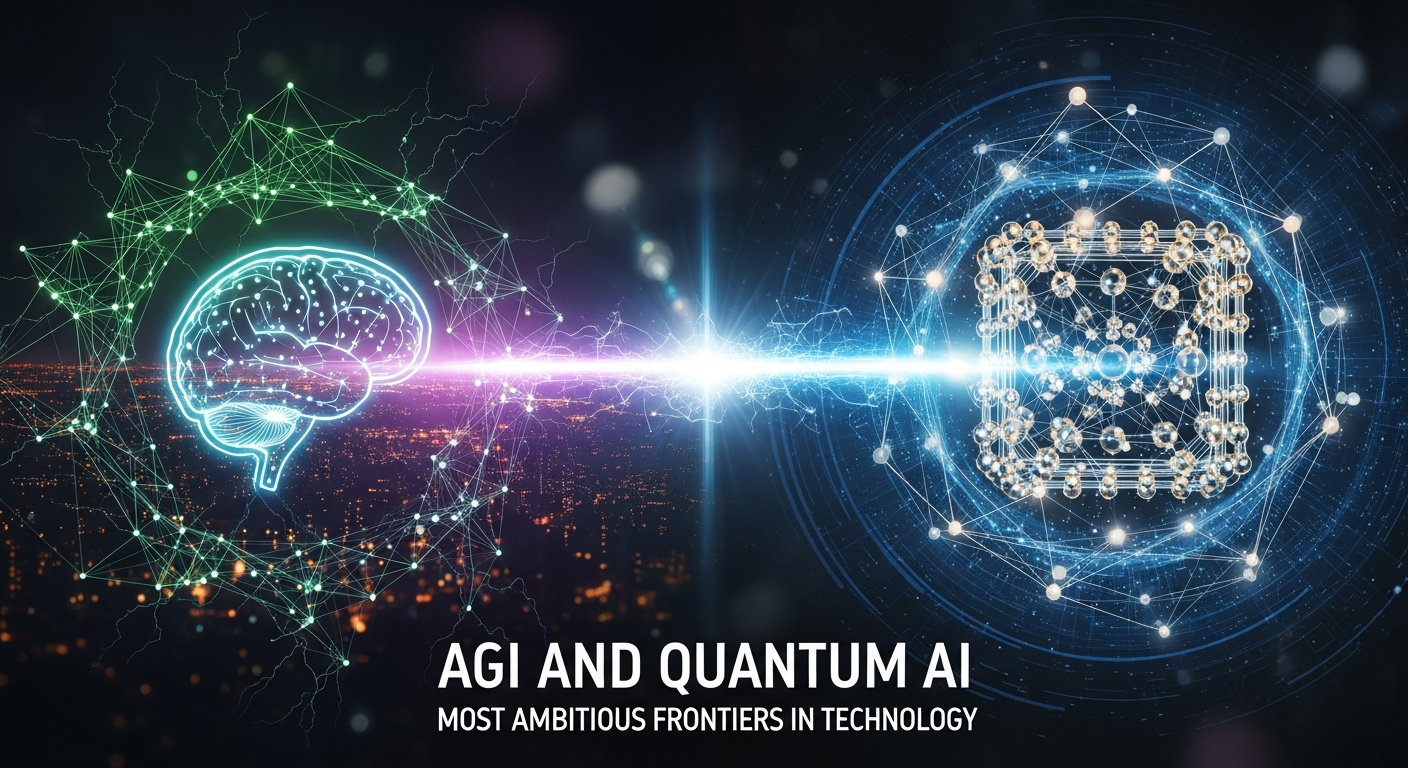

The future is not AGI versus Quantum AI. Rather, the defining revolution of the 21st century may be shaped by the convergence of intelligence and quantum computation, forming a feedback loop of progress capable of accelerating scientific discovery, reshaping economies, and transforming human life.
AGI and Quantum AI
For over half a century, humanity has pursued two parallel technological ambitions: creating machines capable of human-level reasoning and building computers powerful enough to break through classical limits. Artificial General Intelligence (AGI) represents the dream of cognition—systems that can understand, learn, generalize, and innovate like humans across any field. Quantum AI, on the other hand, channels the strange physics of superposition and entanglement to deliver unprecedented computational strength.
Please read this article to know more details…
Understanding AGI
Toward Human-Like Machine Intelligence
AGI marks the next epoch in artificial intelligence—machines that:
- Think and reason like humans
- Transfer knowledge between domains
- Improve themselves without task-specific tuning
- Adapt to new problems the way minds do
Unlike the narrow AI that currently dominates applications like translation, self-driving algorithms, or medical image analysis, AGI aims to become a universal problem-solver.
State of AGI Progress
Recent advances in large language models, deep learning, reinforcement learning, and world-model architectures have dramatically reduced the timeline many experts foresee for AGI’s arrival. Some leading AI researchers now predict AGI could emerge between 2026 and 2029, while others estimate a 50% likelihood between 2040 and 2061.
However, challenges remain formidable:
- Lack of long-term memory
- Limited environmental understanding
- Immense compute requirements
- Alignment and safety risks
- Societal disruption, including large-scale automation
Yet, the potential benefits are staggering. An AGI could uncover cures to diseases, model climate systems with precision, solve unsolved scientific theories, or design entire technological platforms autonomously.
Quantum AI
Computation Beyond Classical Limits
Quantum AI applies quantum computing to accelerate and amplify artificial intelligence. Quantum processors use qubits—units that can exist in many states simultaneously—to solve computational problems classical systems struggle to complete even in astronomical time frames.
Core Strengths
Quantum AI excels in areas requiring intense optimization and simulation, such as:
- Drug discovery
- Climate modeling
- High-dimensional mathematics
- Cryptography
- Logistics and industrial optimization
- Molecular simulation
By exploiting superposition and entanglement, quantum acceleration can outperform even the largest supercomputers for certain tasks. As experiments in 2025 demonstrated, a quantum processor can complete calculations in minutes that could take a classical supercomputer millions of years.
Current Challenges
Quantum computing still faces critical barriers:
- Qubits are fragile and require ultra-cold environments
- Noise and error rates limit long computations
- Hardware remains scarce and expensive
Even so, major industrial roadmaps suggest significant scaling breakthroughs before 2035, including stable logical qubits, large-scale commercial systems, and deep integration with classical AI workflows.
Key Differences Between AGI and Quantum AI
Officials and researchers stress that the differences between the two technologies are structural. AGI focuses on cognition – the software side – aiming to replicate human-like reasoning. Quantum AI concerns infrastructure – the computational muscle that can solve mathematical problems exponentially faster than traditional chips.
Industry analysts project that AGI may require more processing power than current hardware can provide, while quantum systems could struggle to scale without guidance from advanced AI optimization tools.
As a result, experts increasingly describe the technologies as mutually reinforcing rather than competitive.
| Aspect | AGI | Quantum AI |
|---|---|---|
| Core Focus | Human-like reasoning and adaptability | Exponential computational acceleration |
| Foundation | Cognitive models, deep learning | Quantum mechanics and qubits |
| Hardware | Classical chips (GPUs, TPUs) | Quantum processors |
| Timeline | Theoretical but approaching prototypes | Experimental but commercially emerging |
| Nature | Software-driven intelligence | Hardware-driven computational breakthrough |
AGI represents the brain, while Quantum AI represents the computational muscle. One seeks understanding, the other provides the ability to compute more than ever before.
AGI DEVELOPMENT ACCELERATES TOWARD MID-2030
AGI refers to artificial intelligence capable of reasoning and learning across any task at a human level. While today’s AI models remain narrow and specialized, rapid progress in large language models and self-improving architectures has compressed timelines significantly. Several major AI leaders now suggest AGI could emerge before 2030, potentially enabling systems that diagnose medical problems, conduct scientific research, or make strategic decisions without task-specific retraining. This acceleration, however, comes with mounting concerns around safety, energy consumption, and the prospect of widespread automation, with some forecasts suggesting millions of roles could be displaced within 15 years.
QUANTUM AI BRINGS COMPUTATIONAL POWER BEYOND CLASSICAL LIMITS
Quantum AI, meanwhile, leverages quantum processors – machines that use qubits capable of representing multiple states simultaneously – to break through classical computing limits. Supporters argue that quantum hardware could dramatically speed up simulation, optimization, and machine learning workloads, making it possible to analyze data sets or chemical models that even supercomputers cannot process efficiently. Major research groups and technology firms have demonstrated prototype systems, though hardware remains fragile and costly, requiring breakthroughs in error correction and stability before mainstream deployment is possible.
CONVERGENCE COULD RESHAPE SCIENCE, MEDICINE AND THE ECONOMY
If combined at scale, the geopolitical and economic implications could be significant. Quantum-powered AGI systems could accelerate drug discovery, enabling pharmaceutical simulations that shrink development timelines from years to months. Climate researchers could model ecosystems with unprecedented precision, potentially supporting more effective environmental policy. Financial markets, supply chains, scientific research, and cybersecurity could all undergo transformative shifts as AI gains the ability to simulate complex systems rapidly rather than approximate them.
RISKS OF UNBALANCED DEPLOYMENT REMAIN
However, the risks are equally substantial. Quantum systems capable of breaking classical encryption could trigger a global cyber security race, heightening tensions between major powers. AGI systems operating without robust alignment safeguards could act in ways misaligned with human interests. Civil society groups warn that these shifts may further consolidate power among companies and nations with access to quantum computing infrastructure, widening existing inequalities.
REGULATION STRUGGLES TO KEEP PACE
Despite the uncertainty, timelines continue to tighten. Research roadmaps suggest large-scale quantum systems could become commercially viable before 2035, while AGI development continues to accelerate in both corporate and academic labs. Many governments have begun drafting regulatory responses, but analysts caution that current frameworks may struggle to keep pace with the speed of technical advancement.
THE NEXT TECHNOLOGICAL ERA TAKES SHAPE
For now, the industrial outlook is split between enormous opportunity and unprecedented challenge. If AGI provides the intelligence and quantum computing provides the power, their convergence could define the next technological era – one in which the ability to think and compute at scale becomes a core competitive advantage for states, corporations, and institutions around the world.
Conclusion
AGI and Quantum AI are not competitors; they are two halves of the same evolutionary leap. AGI supplies the cognitive architecture—models that reason, learn, and imagine—while quantum computing provides raw computational power beyond classical physics.
Together, they may form:
- The engines of autonomous scientific discovery
- Machines capable of reasoning at planetary scale
- Platforms that redefine healthcare, climate strategy, economics, and technology itself
As one AI pioneer famously noted, we are building systems capable of understanding the universe; the challenge is ensuring they also understand—and uplift—us.



Leave a Reply